Butterscotch

About a year or so I go I began to notice a new dessert item on restaurant menus: butterscotch pudding.  This surprised me because I’ve always associated butterscotch with, well, the sunset dining crew.  The appearance of this humble item was intriguing , but not enough so to get me to order it.

Then I began to wonder–what exactly is butterscotch? Thus far, I’d only experienced it as the ocher colored hard candies “those” people gave out at Halloween.   Turns out, butterscotch is a couple of things.  In liquid form, it’s really just a type of caramel.  In a pudding, it’s synonymous with the flavor of brown sugar.

About a month ago TD asked if I would make butterscotch pudding  (probably subliminally cued by restaurant dessert menus).

So, I did.  And you know what?  It was pretty okay.  We added fresh berries this time around.   However, some chopped pecans and a rum sauce would also be delightful.

…now…if you don’t mind, I’m off to get it on the early bird special at Cocos.

Soundtrack

A little old school funk.

Butterscotch Pudding

borrowed from Joy of Baking who adapted from

Ingredients

3 C (720 ml) whole (full fat) milk 

3/4 C (160 grams) dark brown sugar

1/4 C (30 grams) cornstarch

1/2 tsp salt

4 large egg yolks

1 1/2 tsp pure vanilla extract

2 TBS (28 grams) unsalted butter, cut into small pieces

Directions

  1. In a large stainless steel (heatproof) bowl, whisk together the sugar, cornstarch, salt, and egg yolks.
  2. Whisk in 1/2 cup (120 ml) of the milk until you have a thick paste. Set aside while you heat the milk. Have ready a fine medium-sized strainer and bowl as you will need to strain the pudding after it is cooked.
  3. Rinse a medium-sized heavy saucepan with cold water and then shake out the excess water. Doing this step prevents the milk from scorching.
  4. Pour the remaining milk into the saucepan and bring just to a boil. Gradually pour the hot milk into the egg mixture, whisking constantly, until the mixture is smooth.
  5. Transfer the pudding mixture to a clean large, heavy bottomed saucepan and place over medium-low heat. Cook, stirring constantly, until the mixture thickens to the consistency of mayonnaise (about 2 minutes).
  6. Remove from heat and whisk in the butter and vanilla extract. Pour through the strainer to remove any lumps that may have formed during cooking.
  7. Pour into four bowls or wine glasses. The pudding can be served warm or if chilling, press plastic wrap onto the surface of the warm puddings to prevent a skin from forming. If you like the skin, simply leave the pudding uncovered until cooled, then cover with plastic wrap and refrigerate. The puddings can be made a day or two ahead of serving. Garnish each pudding with a large dollop of softly whipped cream.


How to get a leprechaun to give you directions to his pot of gold

It’s March my friends.  And that means St. Patrick’s Day.  And that means beer.  And Irish names.

A couple of years ago I shared my favorite chocolate cake recipe.   If you’ve been playing along at home, you’ll recall that its secret ingredient is a can of stout beer.  I’m ashamed to admit it has taken me this long to extrapolate the wonders of dark beer and chocolate to brownies.  That’s right, beer.  And brownies.

The good news is that the lightbulb finally went on, and I have a recipe for you.  Like its cousin, the chocolate stout cake, this brownie recipe also begins with a can of beer.  But here, the stout is reduced to about 1/2 cup.  Wait, allow me to explain myself.  I don’t mean that there is less beer.  I mean that it literally gets reduced down via a strong simmer until all that is left is a deep, dark stouty concentrate.  Pwah…less beer.  As if.

Also playing a starring role in this recipe is over a pound of bittersweet chocolate.  Combined with butter and melted until smooth and velvety.

You won’t taste the beer in the brownie.  But, like vanilla or coffee, dark beer boogies with the chocolate to create a deeper, more sophisticated flavor.

I happen to have it on good authority that leprechauns love beer brownies.  So.  Bake up a batch, find a leprechaun and trade for that pot of gold.  Or, keep the brownies for yourself.  The situation is win-win.

Soundtrack

Still stuck on that 80s channel on Pandora.

Stout Brownies

Ingredients

  • 1 can stout (like Guinness or Murphy’s)
  • 18 ounces bittersweet chocolate, chopped
  • .5 lb (16 TBS) unsalted butter
  • 1.25 C granulated sugar
  • 1.5 tsp kosher salt
  • 3 TBS cocoa powder
  • 4 eggs
  • 1 tsp vanilla
  • 2.25 C all-purpose flour
  • 1 C roasted walnuts

Directions

  1. In a medium heavy-bottom saucepan, bring beer to a simmer.  Simmer gently until beer reduces to about 1/2 C.  Remove from heat and let cool.
  2. Preheat oven to 350 degrees.  Line a 9X13 pan with parchment and butter or oil pan and top of parchment.
  3. Using a heavy-bottom saucepan,  melt butter over low heat.  Remove from heat, add chocolate and allow to sit for 3-4 minutes.  Whisk to incorporate chocolate until mixture is completely smooth.  Allow to cool to room tempurature.
  4. In a large bowl, whisk together sugar, salt and cocoa.
  5. Whisk-in eggs one-at-a-time.  Whisk-in vanilla and beer reduction.
  6. Whisk-in chocolate and butter mixture.
  7. Fold-in flour mixture and then nuts until just incorporated.
  8. Pour into prepared pan and bake for 35-45 minutes, until a wooden skewer comes up with moist crumbs when inserted.
  9. Allow to cool completely before cutting.


Mon petit madeleine

As I mentioned a couple of posts ago, I was gifted Thomas Keller and Sebastien Rouxel’s Bouchon Bakery cookbook at the holidays.  After spending several days greedily consuming every page of the hefty tome, I emerged with one question: where to start?  Ever the opportunist, my answer came in the form of shopping.  Specifically, the chance to finally purchase a madeleine pan.

To be honest, while I’ve long wanted to make them, I’d actually eaten a madeleine before I headed off to Sufras to make my purchase.  Luckily,  Sufras has a little cafe and on that day, they had madeleines.  I purchased a few, strictly for research purposes of course.

Like many french treats, the madeleine is an exercise in delayed gratification.  Once the simple ingredients come together, they spend the night in the fridge.  The madeleine pan, coated in butter, spends the night in the freezer.

It’s worth it, I promise.

Each little shell-shaped mold gets a delicate piping of batter.

Et voila!  Gorgeous little tea cakes.

But wait, there’s more.  The original recipe calls for lemon oil.  I happened to be out, but I did have orange oil.   I also had chocolate (really, though, I always have chocolate).  As you’ll discover next week, I already had chocolate and orange on the brain and couldn’t help frosting one-side of each cake with a thin layer of orange infused chocolate.

These are lovely mid-afternoon with a cup of espresso or strong tea.

Thomas Keller, consider this fair warning.  I’m just getting started with you.

Soundtrack

I was in the mood for a little Harry.

Orange and Bittersweet Chocolate Madeleines 

adapted slightly from Bouchon Bakery by Thomas Keller and Sebastien Rouxel

Note–this recipe is really made for utilizing weight-based measurements.  A kitchen scale will make this 1,000 easier.

Ingredients

  • 1/4 C + 3 1/2 TBS (68 g) all-purpose flour
  • 1/2 TSP (2.2 g) baking powder
  • 1/4 TSP (.6 g) Kosher salt
  • 1/4C+ 1 TBS (83 g) eggs (note–using extra large eggs this was almost exactly 2 eggs)
  • 1/4 C + 1 1/4 TSP (55 g) granulated sugar (note–I used superfine)
  • 2.3 Ounces (66 g) unsalted butter at room temp plus more for the pan
  • 2 TSP (9 g) dark brown sugar
  • 1 1/4 TSP (9 g) clover honey
  • 1 to 2 drops orange oil
  • 6 ounces bittersweet chocolate, chopped
  • 12 mold madeleine pan

Ingredients

  1. Sift flour and baking powder together into a medium bowl.  Whisk-in salt.
  2. Combine the eggs and sugar in the bowl of a stand mixer fitted with a whisk attachment.  Mix on medium speed for about 60 seconds.
  3. Increase the speed to high and whip for about 4 minutes until the batter lightens in color and doubles in volume.
  4. While whisking, heat butter, brown sugar and honey in a small saucepan over medium heat, whisking to dissolve sugar.  Remove from heat.
  5. Remove bowl from the mixer and fold in remaining dry ingredients until just combined.
  6. Pour warm butter mixture over the batter and add orange oil.  Fold until incorporated and batter is smooth.
  7. Cover and allow to rest in fridge over night.  Brush pan with melted butter and place in freezer.
  8. Preheat oven to 350 degrees.
  9. Transfer the batter into a pastry bag or ziplock and snip a corner so that the opening is just over 1/2 inch.
  10. Pipe batter into molds.  Tap the bottom of the pan against the work surface to smooth the tops.
  11. Bake for 8 to 9 minutes until the tops are lightly browned and a skewer inserted into the center comes out clean.
  12. Immediately un-mold and place on a cooling rack.
  13. Once cake are completely cool, melt chocolate in a double boiler or microwave.
  14. Using an off-set knife, gently spread a thin layer of melted chocolate on non-etched sides of cakes.  Allow to harden.


Nope, Germany does not have palm trees

I recently learned that TD is a fan of german chocolate cake.   That got the wheels turning.  And, in true pink-peppercorn style I thought; ‘he says he likes german chocolate cake, how about if I make deconstructed german chocolate brownies.’  In my defense, I discovered his affinity because he chose german chocolate cake ice cream at Baskin Robbins.  So…I learned about one thing from another thing and then made something else entirely.  Sounds about normal.

It wasn’t until I was making the dulce de leche that it struck me as odd that something from Germany included coconut as an ingredient.

Now, I’ve never been to Germany, but, I am fairly certain the Bavarian Forest is not home to palm trees.  So, no German coconuts.  Which begs the question–how did the German chocolate cake get its coconut?

The answer?  It didn’t.

The name is actually a bastardization of a recipe that utilized a chocolate by Bakers Chocolate called German’s (after the man who created it).  The original cake (at least according to every source I could find) was created by a Dallas housewife in 1957 and was called German’s Chocolate Cake.  This confection calls a milk-chocolate cake its base and is filled and topped with a pecan, coconut and caramel icing.  In addition to coconut my nod to the original uses dulce de leche and walnuts.  Because, that’s the beauty of baking.

A note on the dulce de leche.  You can buy it if you want.  Even my local understocked grocery store (you know, that one without the mushrooms) carries dulce de leche.  It just happens to cost about $10 a jar.  Do your wallet a favor.  Buy a $1.50 can of sweetened-condensed milk and follow one of the two recipes listed below.  Or, better yet, send me $10 and I’ll make the dulce de leche for you :).

If you like this you might like these

Dulce de Leche

Dulce de Leche Brownies

Soundtrack

The Lads.  I’ll explain later

German Chocolate Brownies

Ingredients

  • 12 ounces chopped milk chocolate
  • .5 lb (2 sticks) unsalted butter
  • 1.5  C sugar
  • scant 1/8 C high quality cocoa powder
  • 1 1/2 tsp kosher salt
  • 4 eggs
  • 2 C all purpose flour
  • 1 C toasted walnuts, chopped
  • 1 C (or more to taste) shredded coconut
  • 1 C mini bitter or semi sweet chocolate bits
  • 1 1/2 C dulce de leche (store bought or make your own here or here)

Directions

  1. Preheat oven to 350 degrees.  Line 9X13 pan with parchment and butter entire pan
  2. Using a heavy-bottomed sauce pan, melt butter on low.
  3. Once butter is melted, add chopped milk chocolate, remove from heat and let sit for 2-3 minutes.
  4. Whisk chocolate and butter until smooth.   Allow to cool to room temp.
  5. In a large bowl, whisk together sugar, cocoa and salt.
  6. Whisk-in eggs one-at-a-time, combining fully between each.
  7. Whisk-in milk chocolate mixture.
  8. Gently fold-in flour until just combined.  Fold-in walnuts, chocolate bits and coconut.  Transfer to prepared pan.
  9. Using a spoon, add dollops of dulce de leche at regular intervals (3 rows of 5 dollups should do you). Run a skewer through the caramel and batter to distribute.
  10. Bake for 34-45 minutes or until an inserted tester or toothpick comes out with moist crumbs when inserted.


Yes Please!

During the holidays I was somehow lucky enough to receive not one but two Bouchon Bakery cookbooks as gifts.  Alas, you’ll have to wait for a report on my adventures with Bouchon for another day.  Today we’re visiting what I traded the second Bouchon cookbook for: Jerusalem.  I’ve had my eye on this beautifully photographed and narrated cookbook by Yotam Ottolenghi and Sami Tamimi since it popped onto the scene last October.  I’ve long been intrigued by  cuisines that cross boundaries as a result of geographic and cultural proximity.  For me, there has also always been a deep stirring for this part of the world, a sort of calling of some memory from generations ago.  Most likely I’ve romanticized the idea, but there is a part of me that, despite a complete lack of hereditary evidence, believes this is where I started.

Genetics notwithstanding, it should be no surprise that I started the book with the sweets section. Specifically, a gorgeous pair of chocolate krantz cakes.  While the name was new to me, I’ve long been familiar with this particular delicacy in the form of babka.  Nearly identical in recipe, babka is the  Eastern European Jewish name for Israeli Jewish krantz cake.

Perhaps the exact opposite of a quick bread, krantz cake takes a day or so but is incredibly satisfying to make.

Yeast dough is topped with chocolate, pecans and sugar and rolled into a thick cigar. I apologize for the awful picture but…but the roll needed to be shown.

Then the real fun begins.  The roulade is split down the middle longways.

And twisted into a pretty braid.

One last proofing gives the dough a little volume.

This is one of those recipes that smells ridiculously delicious while in the oven.

Out of the oven you’ll wonder; ‘holy smokes, did I just make this?’  Oh, but there is more.  The piece de resistance is a thorough drenching of the still warm cake with simple syrup.  Now, you’ll ask yourself, ‘really, is this last step necessary on top of such obvious decadence.’  Yes, it is.

Quick recipes have a serious place in my heart.  In fact, I consider myself the queen of the brownie (at least in my own little kingdom of TD and a couple of Kitchen Gods).  But, this recipe was an absolute pleasure to make with an outcome equal to the time.

Soundtrack

Depeche Mode.  I know right?

Chocolate Krantz Cakes

from Jersualem, by Yotam Ottolenghi and Smi Tamimi, Ten Speed Press

Ingredients

CAKE

  • 4 1/2 C (530 grams) all purpose flour plus extra for dusting
  • 1/2 C (100 grams) superfine sugar
  • 2 tsp fast-rising active dry yeast
  • grated zest of one small lemon
  • 3 extra-large eggs
  • 1/2 C (120 ml water)
  • rounded 1/4tsp salt
  • 2/3 C (150 grams) unsalted butter at room temp. cut into 3/4 inch cubes
  • sunflower oil for greasing

CHOCOLATE FILLING

  • scant 1/2 C (50 grams) confectioner’s sugar
  • 1/3 C (30 grams) best quality cocoa powder
  • 4 1/2 ounces (130 grams) good quality dark chocolate, melted
  • 1/2 C (120 grams) unsalted butter, melted
  • 1 C (100 grams) pecans, coarsely chopped
  • 2 TBS superfine sugar

SYRUP (enough to cover both cakes)

  • 2/3 C (160 ml) water
  • 1 1/4 C (260 grams) superfine sugar

Directions

FOR THE DOUGH

  1. Place the flour, sugar, yeast and lemon zest in a stand mixer fitted with a dough hook and mix on low for 1 minutes.
  2. Add the eggs and water and mix on low speed for a few second, then increase the speed to medium and mix for 3 minutes, until the dough comes together.
  3. Add the salte and then start adding the butter, a few cubes at a time, mixing until it is incorporated into the dough. Continue mixing for about 10 minutes on medium speed, until the dough is completely smooth, elastic and shiny.  During the mixing, scrape-down the sides of the bowl a few times and throw a small amount of flour onto the sides so that all of the dough leaves them.
  4. Place the dough in a large bowl brushed with sunflower oil, cover with plastic wrap and leave in the fridge for at least half-a-day (overnight is best).
  5. Grease two 2 1/4 lb loaf pans (9X4 inches) with some sunflower oil and line the bottom of each pan with a piece of parchment paper.
  6. Divide the dough in half and keep one-half covered in the fridge.
  7. Make the filling by mixing together the confectioners’ sugar, cocoa powder, chocolate and butter into a spreadable paste.
  8. Roll-out the dough on a lightly floured surface into a rectangle measuring 15X11 inches.  Trim the sides to make them even.
  9. Use an offset spatula to spread half the chocolate mixture over the rectangle, leaving 3/4 inch border all around. Sprinkle half the pecans on top of the chocolate, then sprinkle with half the superfine sugar.
  10. Brush a little bit of water along the long end furthest away from you.
  11. Use both hands to roll-up the rectangle like a roulade, starting from the long side that is closest to you.  Be sure to roll tightly.
  12. Press to seal the dampened end onto the roulade and then use both hands to even out the roll into a perfect, thick cigar.  Rest the cigar on its seam.
  13. Trim about 3/4 inch off both ends of the cigar with a serrated knife.
  14. Using a serrated knife, gently cut the roll into half lengthwise, starting at the top and finishing on the seamm.
  15. With the cut sides facing up, gently press together one end of each half and then lift the right half over the left half.  Repeat the process, but this time lift the left half over the right.
  16. Gently squeeze together the other ends so that you are left with the two halves, intertwined, showing the filling on top.
  17. Carefully lift the dough into a loaf pan.
  18. Cover the pan with a wet tea towel and leave to rise in a warm place for 1-1 1/2 hours.  The cake will rise by 10-20 percent.
  19. Repeat with second ball of dough.
  20. Preheat oven to 374 degrees.
  21. Remove the tea towels, place the cakes on the middle rack of the oven and bake for about 30 minutes, until a skewer inserted in the center comes out clean.
  22. While the cakes are in the oven, make the syrup.
  23. Combine the water and sugar in a saucepan, place over medium heat and bring to a boil.
  24. As soon as the sugar dissolves, remove from te heat and leave to cool down.
  25. As soon as the cakes come out of the oven, brush all of the syrup over them.  Use up all the syrup.
  26. Allow cakes to cool until just warm, then remove from the pans and let cool completely before serving.

Black and white

The first time I ever had a black and white cookie was at a Superbowl party in West Hollywood.  The West Hollywood part of the experience was important for two reasons.  First, given the location of the party, I’m fairly certain those giant disks of delightfulness came from Canters Deli. Canters is a Westside institution.  Think Jewish Grandmother meets Swingers (the movie). Open 24 hours, it’s also one of the few places in Los Angeles where you can get a bowl of matzo ball soup to help repair whatever it was that you might have done to yourself earlier in the evening.  To this day don’t think I’ve experienced Canters before midnight.  Canter is also famous for its bakery.  So, returning to the Superbowl party, my first black and white cookie experience set the bar high.

That party (and its location) is notable for another reason.  Having been to my fair share of similar events, at first I couldn’t figure out what was different about this one.  Lots of people in a festive mood?  Check.  Adult beverages?  Check.  Good food?  Yep.  It wasn’t until halftime that I figured it out.  During the game, the volume in the house rose considerably.  People mingled.  People ate and drank.  But, during the commercials?  Silence.  Every head was turned in rapt attention toward the television.

Only in Hollywood would people gather for a Superbowl party to watch the commercials, not the game.

I’ll admit, I can’t remember who played in that game.  I don’t remember the commercials either.  But, I have developed a fondness for black and white cookies.

I’m surprised that it has taken me this long to attempt making them.  But, they aren’t very common on the West Coast, so it’s probably a case of out of sight out of mind.

New York claims this cookie as its own, so I went to my favorite New York food blogess for this recipe, Smitten Kitchen. I made mine a little smaller so as to spread the love a little wider.

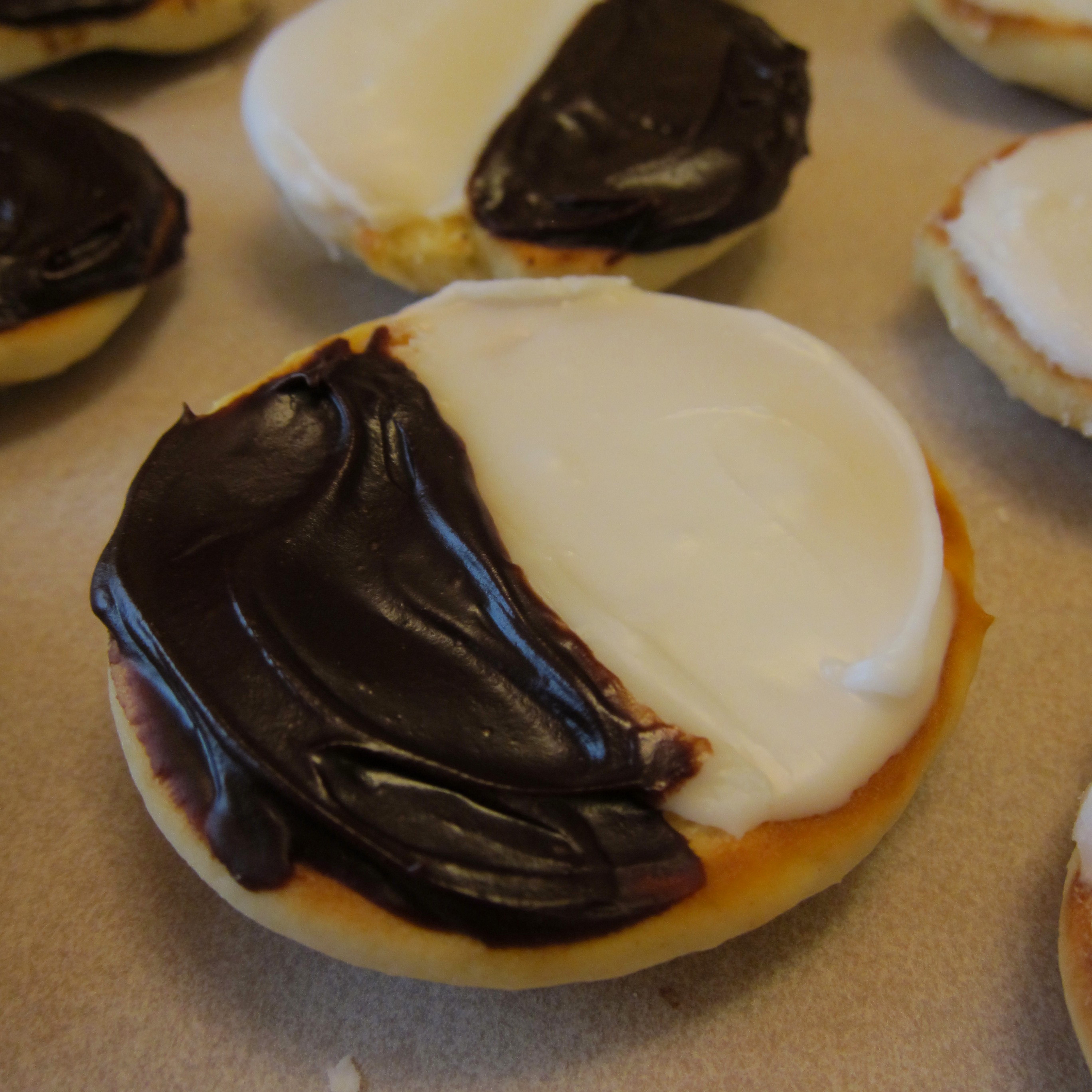
Not to ruin the romance, but, there is a particular way I like to eat black and white cookies.  Peel off and eat white frosting first.  Then the chocolate.  Then the cookie/cake.  I point this out because not all icings form a flexible enough skin to allow for this.  Should you also prefer to consume your black and whites this way, let me assure you that the following recipe delivers.

Soundtrack

The Heavy

Black and White Cookies

I’ve linked directly to the Smitten Kitchen because this is her recipe.  Smitten Kitchen was my first introduction to food blogging.  Actually, to any blogging.  And, every time I read Deb’s blog (I make it sound like I know her), I am reminded of just how lucky I was that she was my first.

The Spaulding

Right after finishing college but before starting graduate school, I lived with two friends in the heart of the Fairfax District.  It was a very well rounded neighborhood complete with orthodox Jewish families, a transvestite with fantastic legs and, of course, lots and lots of “actors.”  Years after the three of us left the neighborhood, a plane crashed into the apartment building across the street.

Being  young, nubile, recent college graduates, the three of us entertained quite a bit.  At one such get together, the Spaulding was born.  Like most good cocktails, its origins are hazy though I’m fairly certain this was a an adult beverage derived from convenience.  We had vodka.  We had ginger ale.  We had limes.  We had ice.  We lived on North Spaulding Avenue between Melrose and Beverly.  A cocktail was created.

It wasn’t until at least a decade later that I realized “our drink” is really just the Moscow Mule’s significantly less sophisticated sibling.

Early in our courtship, I turned TD onto the Spaulding (he was very disappointed it wasn’t named after Spaulding Smails.  In fact I think his direct quote was “double turds.” To this I responded, “you’ll get nothing and like it”).  Despite his ire, TD liked the drink and somewhere along the way, it became our preferred party beverage.  In fact, if you happened to get married in the last 15 years or so and TD and I happened to be at your nuptials, we probably enjoyed a Spaulding or two in your honor.

I know this isn’t much of a recipe, but it’s a drink we enjoy often and a tiny bit related to next week’s post.

Soundtrack

Foster the People, a little summer music

The Spaulding

  • 2 ounces vodka
  • 4-6 ounces gingerale
  • lots of lime

Add everything in over ice.  Give it a mix.  Enjoy!


Old and New

It wouldn’t be January in the Misanthropic kitchen without a grapefruit recipe.  In fact, I started thinking about what to make way back in November (I am convinced there is a relationship between losing the light as the year grows old and craving the brightness of vitamin C-packed fruit).  This year there were two front-runners.  However, as it is my enduring goal to have my cake and eat it too, I decided to use one with a different kind of citrus (to be continued in February) and chose a new twist on an old recipe for my beloved grapefruit.

We’ll start with the twist: grapefruit and basil syrup. I know, I know basil is generally a summer flavor.   But, I couldn’t shake the idea and so decided that if I could find it at my local, generally understocked grocery store, it might be something others could also find this time of year.  For frame of reference, on the day I went in search of ingredients, there were no mushrooms to be found at the store we lovingly refer to as Ghetto Ralphs.  But, there was basil.  It was on the expensive side.  But remember, it’s grapefruit season which means they were practically giving them away.

Grapefruit rind+ a couple of cups of fresh basil leaves+sugar and water+heat=the kind of smell you’d like to dab behind your ears.

Now for an oldy but a goody, Ina Garten’s lemon yogurt cake.  Riffing on a recipe is always easier when you know the original is a ringer.

I just swapped-out the lemon zest for grapefruit zest and, because I was feeling adventurous, used a runnier, European style full-fat yogurt.  Both substitutions were a success.

The loaf on its own is lovely.  But, we know the key to this cake is the syrup poured over the top while still warm.  And this is where our basil and grapefruit syrup makes its debute.  The result?  Refreshing!  The basil adds complexity to the flavor without being overwhelming.

For an added bonus, the leftover syrup will store nicely in the fridge for a few weeks because really, who wouldn’t want a little grapefruit-basil-vodka cocktail on a Friday afternoon?

If you liked this, you might like these

Grapefruit Whoopie Pies with Avocado Filling

Triple-Quadruple Grapefruit Cupcakes

Soundtrack

Vampire Weekend

Grapefruit-Basil Loaf

adapted from Ina Garten

Grapefruit and Basil Simple Syrup

Ingredients

  • 2 C basil leaves
  • 1 C sugar
  • 4X1 inch strips of pink or ruby red grapefruit zest
  • 1 C water

Directions

  1. Bruise the basil leaves bit with your hands to release the oils.
  2. Place basil, sugar, water and zest in medium heavy-bottomed saucepan.  Turn on medium heat and let it come to a boil and allow the sugar to dissolve.
  3. Turn off heat.  Allow mixture to steep for at least an hour while it cools to room temperature.
  4. Strain syrup through a fine-meshed sieve and store in an airtight container in the fridge for up to a month.

Grapefruit Loaf

Ingredients

  • 1 1/2 cups all-purpose flour
  • 2 teaspoons baking powder
  • 1/2 teaspoon kosher salt
  • 1 cup plain whole-milk yogurt
  • 1 1/3 cups sugar, divided
  • 3 extra-large eggs
  • 1 TBS pink or ruby red grapefruit zest
  • 1/2 teaspoon pure vanilla extract
  • 1/2 cup vegetable oil
  • 1/3 cup grapefruit and basil simple syrup

For the glaze:

  • 1 cup confectioners’ sugar
  • 2 tablespoons freshly squeezed grapefruit juice

Directions

  1. Preheat the oven to 350 degrees F. Grease an 8 1/2 by 4 1/4 by 2 1/2-inch loaf pan. Line the bottom with parchment paper. Grease, flour and line pan with parchment.
  2. Sift  together the flour, baking powder, and salt into 1 bowl.  In another bowl, whisk together the yogurt, 1 cup sugar, the eggs, grapefruit zest, and vanilla. Slowly whisk the dry ingredients into the wet ingredients. With a rubber spatula, fold the vegetable oil into the batter, making sure it’s all incorporated. Pour the batter into the prepared pan and bake for about 50 minutes, or until a cake tester placed in the center of the loaf comes out clean.
  3. When the cake is done, allow it to cool in the pan for 10 minutes. Carefully place on a baking rack over a sheet pan. While the cake is still warm, pierce cake all over with a bamboo skewer than pour the grapefruit and basil syrup over the cake and allow it to soak in. Cool.
  4. For the glaze, combine the confectioners’ sugar and grapefruit juice to desired consistency and pour over the cake.

The macaron rides again

Ever since I was left with three-quarters of container of toasted black sesame seeds they’ve been calling to me from the “S” section of the spice rack in our pantry.  So I thought, what if I replaced some of the almond flour in my french macaron recipe with black sesame flour?

My base recipe calls for 120 grams of almond flour.  I swapped-out 50 grams of almond meal for 50 grams of ground black sesame seeds.  Now, generally, the taste of macaron shells is very delicate, bland even.  In fact, most of the actual flavor from these sandwich cookies comes from the filling.

So, I was very surprised at how flavorful the batter was.  In fact, you could probably reduce the ground sesame seeds to 30 grams and still achieve toasted nuttiness.  I love the color of the batter.  I used almond flour from shelled almonds.  Trader Joes sells an almond flour with the shells ground into it that would give these little gems even more depth.

Even with the significant sesame content, I got feet.  Though, a true coniseuer would point out that the feet are horizontal suggesting a too-hot oven.  Whatever.

I liked the honey and black sesame combination used to make sesame paste and went on the hunt for a honey-based filling.

The original recipe called for sour cream, but I was curious and swapped it out for full-fat yogurt.  I liked the resulting tang, but you can do what you’d like.

I wanted something to balance the sweetness of the honey and the nuttiness of the sesame shells.  A little hidden dollop of orange marmalade to the very center of each macaron did the trick.

We already know what a lovely affair the relationship between french and asian techniques and flavors can produce.  And what more perfect venue is there than the frilly and vain macaron to play with interesting and exotic combinations?

Soundtrack

Fun.  I can’t help it, I love those guys.

If you liked this you might also like these

Raspberry macarons with pink peppercorn buttercream

Chocolate macarons with peanut butter filling

Black Sesame French Macarons with Honey Yogurt Filling

I’ve chronicled my adventures with French macarons thoroughly here and here and here.  Read the first link for specifics on technique.

Ingredients

For the shells:

  • 90 grams egg whites
  • 30 grams granulated sugar
  • 200 grams confectioner’s sugar
  • 70 grams ground almonds or almond flour
  • 50 grams ground toasted black sesame seeds (a spice grinder yielded beautiful sesame seed flour)

Directions

I like to use a stencil when I pipe my shells.  On parchment, I trace circles of desired size (20 for a half-sheet).  When it’s time to pipe, I lay an additional sheet of parchment over the pattern and cook the shells with both sheets.

  1. Preheat oven to 300 degrees.  Place rack in center of the oven.
  2. Combine confectioner’s sugar, almond flour and ground sesame seeds in the food processor until well combined.  Sift mixture into a medium bowl and set aside.
  3. Add egg whites to the bowl of a standing mixer fitted with a whisk attachment or use a hand mixer.  Whisk on low until egg whites are fluffy.  Turn up speed to medium and slowly add-in the granulated sugar.   Continue to whisk egg whites until they just hold a peak.
  4. Gently fold 1/2 of the dry ingredients into the eggs whites.  Fold until just combined.  Add-in the remaining dry ingredients and fold until the batter resembles lava.  Do not over mix!
  5. Using a pastry bag or ziplock, pipe shells onto baking sheet.
  6. Set aside for 30 minutes until the shells begin to harden.  Bake for 10-12 minutes.  Allow to cool before gently removing from parchment.

Honey-yogurt filling

Adapted from www.cupcakeproject.com

This will easily fill about 20 complete macarons

Ingredients

  • 1/4 C unsalted butter at room temp
  • 1 C confectioner’s sugar
  • 1/8 C honey
  • 1/8 C full-fat yogurt

Directions

  1. In a standing mixer fitted with the paddle attachment (or using a hand-mixer), cream together the butter and sugar. Until light and fluffy.
  2. Add in a little confectioner’s sugar at-a-time until combined.
  3. Add-in honey and yogurt, mix to desired consistency.
  4. I find it easier to pipe the filling onto the macarons  when the filling has been refrigerated.

I found the flavors melded nicely after the macarons were aged int he fridge a couple of days.


Buttermilk Biscuits

Happy New Year to you all!  I hope your holidays were delightful.  As you can see, TD and I survived our trip to Montana and escaped the zombie apocalypse.

I was assigned to make biscuits for our family’s Christmas breakfast.    So, on Christmas Eve, while this was going on outside (yes, that is fahrenheit):

Which helped to make this happen:

I got down to biscuit business.

Biscuits from scratch are just as easy as biscuits from Bisquick if you keep one think in mind: DO NOT harass your biscuits.  Mix, combine, touch and roll the dough much LESS than you think you need to, and you’ll be fine.

The recipe I used called for a combination of butter and shortening.

And, because I’m lazy, I used my mother’s ancient food processor.

Pulsing is the name of the game.  Piece-by-piece pulse your fat into your dry ingredients.

Then, pulse in the buttermilk and run the processor until the dough just comes together.  After that, go over and say hello to Gregory (Wood)Peck(er).

On a floured surface, shape your dough into a rectangle about an inch thick.  You can roll if you want, but, only as a last step.  Trust me, the dough will do what you tell it to do. Then, using a cookie cutter, biscuit cutter or knife, cut out the individual biscuits.  According to the Clinton Street Bakery, the source for the recipe I used, the trick is to not twist the cutter when cutting.  Just go straight down until you hit the board (this was harder to resist than I thought it would).

My parents live at about 5500 feet elevation, so I wasn’t entirely certain the biscuits would rise.  In fact, I was completely prepared to take the results  down to the frozen creek and use them as hockey pucks.

Luckily, beautiful fluffy biscuits emerged from the oven, not edible sports paraphernalia.  Which means, you’ll have no trouble at all!

Soundtrack

The Andy Williams Christmas CD

Clinton Street Buttermilk Biscuits

adapted slightly from Neil Kleinberg’s recipe as it appeared in Food and Wine

Ingredients

  • 1 cup all-purpose flour, plus more for dusting
  • 1 cup cake or pastry flour
  • 2 teaspoons baking powder
  • 1/2 teaspoon baking soda
  • 1 teaspoon sugar
  • 1 teaspoon salt
  • 3 tablespoons cold unsalted butter, cut into small cubes
  • 3 tablespoons cold shortening
  • 3/4 cup plus 2 tablespoons buttermilk

Directions

  1. Preheat the oven to 425°.
  2. Into a medium bowl, sift the flours with the baking powder, baking soda, sugar and salt.
  3. In a food processor, pulse dry ingredients a couple of times.  Using the pulse function, add in  the butter and shortening a couple of pieces at-a-time until the mixture resembles coarse meal. Add the buttermilk and run the processor just until a dough forms. Turn the dough out onto a lightly floured surface and knead 2 or 3 times.
  4. Pat or roll out the dough 3/4 inch thick. Using a lightly floured 2 1/2-inch round biscuit cutter, stamp out 12 biscuits. Dust the top of each biscuit with flour.
  5. Transfer the biscuits to a greased baking sheet. Bake for 15 minutes, or until the tops are lightly browned; serve.