A rose by any other name might just be a succulent

I may just be the harbinger of doom when it comes to flora.  Houseplants see me coming and shrivel up on there own to save themselves the agony of a slow death at my hands.  So egregious are my crimes against plant life that I’m surprised I’m not on some sort of nursery no-fly list.

Really, it’s not my fault.  I blame my parents.  As the child of two avid gardeners, I can’t think of a single time during my misspent youth when I had to pull weeds.  I’ve never mowed a lawn.  In fact, my parents assigned my brother and I chores so that we wouldn’t mess-up their yard (I was the designated pool girl and can skim leaves with the best of them).  So, it should not be a surprise to anyone that I can’t grow anything.

Well, maybe one thing.  A couple of years ago I bought a succulent wreath for our front door.  I’d liked the colors and didn’t want to put something fake up.  And you know what?  That little bugger is still alive.  In fact, last summer a bird built a nest in it and raised three little birds (yes, I played Ziggy Marley for them as much as possible).  Encouraged by the success of the door wreath, I planted a couple of big pots of assorted succulents on our roof-deck.  And they’ve done really well too.  Ha!  So, when I wanted to bring some green inside, succulents seemed like the only logical choice.

After conducting a little bit of research I found that my idea wasn’t all that unique.  In fact, a visit to a high-end nursery revealed that succulent terrariums are sort of all-the-rage.  However, at about $200 a vessel retail, I figured I could probably make my own.  So I did.  And now I’m sharing the how-to with you.

You’ll want to start with some succulents.  I pulled together a variety of different colors and textures.

You’ll also want a vessel,  pot, bowl, jar with a wide-mouth.

Gravel or small rocks, cactus soil and some gardener’s sand round out your list of ingredients (all can be found at even the most basic of nurseries or garden departments).

To build your terrarium, begin with a two-inch layer of gravel.  This will allow for drainage.

Follow this with another couple of inches of cactus soil.

Now it’s time to plant.  Depending on what you are going for, you can use a single plant or put together a little arrangement of smaller plants.  I did both.  Once you’ve got your plants in place, top the layer of soil with a layer of sand.  And, easy as that, you’ve got a living arrangement.

Cluster arrangements together for even more texture.

And the cool part?  They only need to be watered every couple of weeks.  I made these a month ago and they are ALL still alive.  A minor miracle in the misanthropic household.

Festivus Cake

All professional photo credits (and it’s obvious which are professional): Betwixt Studio.

Four years ago today at about five in the afternoon, TD and I finally made honest people out of one-another.  That’s right, we gathered about a hundred of our favorite people together and got hitched, institutionalized, joined together as one, holy matrimonied, entered into a civil union.  It was a  good day.

The best.

We laughed, we cried, I wore fabulous shoes,  we ate hot fudge brownie sundaes.  It could not have been a more perfect way to kick-off the rest of our lives.  With one exception.  The cake.   Now don’t get me wrong, our cake  was just fine.  Even better than fine even.  It was huge.  HUGE. And beautiful.

And, well, sort of boring.

After tasting cake at no fewer than half-a-dozen bakeries, we settled on lemon.  With some sort of lemon filling (but not curd) and buttercream frosting. Safe.  Classic.  Sure to please the crowd.   But what we really wanted?  What we’ve been talking about in the four years since?  Coconut cake.  With a lime curd filling and fluffy white chocolate buttercream.

I think four years of marriage and nearly eleven years of thick, thin and everything in between deserves a little lime in the coconut. Don’t you?

My search for the perfect coconut cake was satisfied by a recipe posted in the L.A. Times years ago.  It is in fact, a great recipe.  The cake is dense with a very fine crumb and hearty enough to stand-up to whatever you want to top it with.  Without frosting, it makes great coconut muffins. I will say that this recipe takes some time.  It calls for separating the eggs and then beating the yolks until pale and creamy.

These are added to a butter and sugar mixture.

Dry ingredients are added alternating with coconut milk and then whipped egg-whites are folded-in at the last minute.

While the cake was in the oven, I turned my attention to the lime curd.  Of course you can buy great lime curd at the store.  But, it’s cheaper to make your own.

Over a double-boiler, butter, lime juice, zest, sugar and eggs are gently cooked until thick.

Cooled and stored in a jar or container, lime curd will last for weeks.  Which is good because I made the cake and curd the week before I actually assembled the cake.  I froze the cake so it would be easier to split and the curd was stored in the fridge where I, of course, had to try it every day just to make sure it was still good (it was, oh yes, it was).

On the day of construction, all that needed to be made was the frosting.  As you know there is more than one way to frost a cake.  For this particular cake I used a very rich, very sugary white chocolate butter cream.  This is serious stuff and great for decorating.

Melt some white chocolate together with a quick pour of milk (I used buttermilk).

Whisk until smooth and set aside.

Then, cream butter and vegetable shortening together (you can use all butter if you want.  I wanted a frosting that would stand-up to a little abuse and so used the shortening for body). To this, eight–yes 8 cups of confectioner’s sugar are slowly added.

Until everything is very stiff and formal and your kitchen takes on that crunchy-sweet smell of a professional bakery.

And finally, the white chocolate is gently blended into the whole mess.

After leveling and splitting the cake, it was time to assemble.  For the first phase, I filled a pasty bag with about a third of the frosting.  This just makes it easier for construction.  So that the lime curd didn’t squeeze out the sides, each layer first got a protective barrier of frosting.

Then I spread a thin layer of curd and carefully covered the curd with a layer of frosting.

Repeat three times.

Then,  I covered the whole thing in a thin crumb layer and let it chill a bit in the fridge.

When ready to frost, I covered the whole thing in a nice, thick layer of frosting.  To be honest, I’m not much of a decorator.  In my experience, the less I “mess” with the decoration, the better the product tastes.  But, since this was for a special occasion, here is what I did.  After frosting the whole thing, I dipped my off-set spatula in really hot water.  After quickly drying it, I smoothed-out the frosting on the cake, repeated until I’d sort of “slicked-down” the entire cake (the picture below is pre-slicking).

Then I added some frills along the edges and some curled white chocolate to the top.  Et voila!  Festivus cake!

The lime curd helped balance-out the sweetness of the frosting which played well off-of the rich nuttiness of the coconut.  Sort of like TD’s and my marriage.  He’s the sweet, I’m the tart and we’re both a little nutty. Ahhhahha…be sure to tip your server at the end of the night, I’ll be here all week.

Why is it called Festivus Cake?  Well.  When TD and I got engaged, people kept asking us what the theme of our wedding would be.  Theme?  Wasn’t marriage enough of of theme?  Apparently not.  So at some point TD began telling people that we had chosen a Festivus theme.  What with the feats of strength and airing of grievances, we figured it was wholly appropriate.  The name stuck and our pending nuptials were thus referred to as Festivus.

Before the recipe, I’ll leave you with one of my favorite pictures from our wedding.  Amy and Maurice from Betwixt Studios produced hundreds of aesthetically stunning “memories” from our wedding.  This is NOT one of them.  We both look like we’ve got sticks up our butts; a sort of Southern Californian Gothic.  While it isn’t particularly flattering of either one of us, this photo makes me laugh every time I see it.  And laughter is what I think of when I think of that day and our lives together (yes, this is true even when it’s really, really, really hard).

Festivus Cake

Coconut Cake

Adapted from The Ultimate Coconut Cake, L.A. Times

Ingredients

  • 1 C unsalted butter, room temperature
  • 3 C sugar (I used superfine)
  • 4 eggs, separated
  • 4 1/3 C cake flour, sifted
  • 1 1/2 TBS baking powder
  • 1/2 tsp salt
  • 2 C coconut milk (most coconut milk comes in 11-14 ounce cans, just make up the difference with regular milk or buttermilk)
  • 1 tsp vanilla extract

Directions

Preheat oven to 350 degrees.

Grease, flour and line with parchment 3 (8 or 9-inch) round cake pans

  1. Sift together the flour,  baking powder and salt into a bowl, set aside.
  2. Using a hand-mixer or the whisk attachment in a standing mixer, cream the egg yolks until pale and thick.  Set aside.
  3. Wash and dry beaters. In a separate bowl, whip egg whites into soft peaks. Set aside.
  4. Cream the butter until light and fluffy.  Gradually add the sugar and beat until very light, two-to-three minutes.  Add beaten egg-yolks to the butter mixture blending well.
  5. Add flour mixture and coconut milk to butter in three parts, beginning and ending with the dry ingredients.  Add-in vanilla and beat thoroughly.
  6. Fold-in beaten egg whites.  Pour batter into prepared pans, spreading to the edges (batter will be very thick).  Bake until a toothpick inserted into one of the cakes comes out clean, 35 minutes.  Cool 15 minutes.  Loosen and invert onto racks to cool completely.

Lime Curd

adapted from allrecipes.com

Ingredients

  • 1 C superfine sugar
  • 1/4 C butter
  • 3/4 C fresh lime or key lime juice
  • 1 TBS lime zest
  • 2 eggs, beaten

Directions

  1. Place the sugar, butter, lime juice and lime zest in the top of a double boiler.  Stir over medium-high heat until the butter melts.
  2. Mix 2 TBS of the hot lime mixture into the beaten eggs and stir to blend.
  3. Reduce heat to medium until water just simmers.  Slowly whisk egg mixture into the lime and sugar mixture.  Cooke until mixture thickens and coats the back of a wooden spoon: about 30-25 minutes.
  4. Let cool and spoon into glass container.  Cover and refrigerate.

White Chocolate Buttercream Frosting

adapted from Wilton

Ingredients

  • 18 ounces white baking chocolate, chopped
  • 1/4 C milk
  • 1 C solid vegetable shortening
  • 1 C butter at room temperature
  • 1 tsp vanilla extract
  • 8 C confectioner’s sugar
  • 1/4 C milk (yes, this is on here twice for a reason)

Directions

  1. Microwave chocolate with 1/4 C milk on medium for 1-2 minutes stirring halfway through cooking time.  Chocolate may not appear entirely melted.  Whisk mixture until all lumps are smoothed.  This can also be done in a double boiler.
  2. Cream butter and shortening.  Add vanilla.
  3. Gradually add sugar, one cup at-a-time beating well.  Scrape sides and bottom of bowl often.  When all sugar is mixed-in, icing will appear very dry.
  4. Add milk and beat at medium speed until light and fluffy.
  5. Fold in chocolate and mix until blended.

If you aren’t going to use immediately, cover frosting so that it does not dry-out.

Assemble cake as desired.

P.S. Apparently Festivus also includes the sending of embarrassingly (who am I kidding, I’m not embarrassed in the slightest) huge and gorgeous flowers.

A brave and delicious book

So, I’d like to tell you about a book I just finished.  It really was delicious.  And brave.  And funny.  And often, painful. It was real.

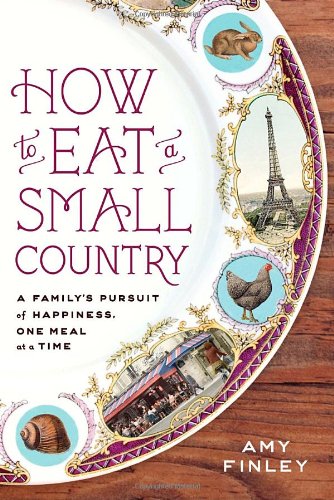
I’m talking about Amy Finley’s How to Eat a Small Country.

In the spirit of full disclosure, you should probably know that I know Amy.  During college we worked together for a couple of summers at UCLA’s alumni resort, Bruin Woods.  When you spend two summers up in the mountains with 49 other college students and a weekly rotation of alumni, you get to know one another pretty well.  At least as well as you can know a person at that moment in time.

Here is what I know about Amy: she is a wonderful storyteller.  I remember standing on the pool deck (I was an occasional lifeguard) listening as she and her co-counselor spun intricate stories on-the-fly about the folklore of the evil Tommy Troll (why yes, that is a thinly veiled reference) and his marauding antics in and around the local geography of Lake Arrowhead (on which shores our little resort sits).  I loved those stories and was in awe of how easily the clever tales rolled-off her tongue.

So, I was very excited to read her first book.

You might also know Amy.  She won the third season of The Next Food Network Star.

She earned the brass ring, did six episodes of her show The Gourmet Next Door and then disappeared.

How to Eat a Small Country is a memoir about what happened next.

I was expecting a technicolor journey described in gorgeous countrysides and drool-on-the-page cuisine with a nice little story about the family along the way.  And the book delivers on the scenery and the eats.  The part about the family however, is exponentially more complex–and where the true beauty of the book lies.

As anyone who is or has been knows, marriage is really, really, really hard.  It’s hard when it is good.  It’s hard when it is bad.  It’s just hard.  And here is where Amy’s story starts.  Right in the middle of the hard part.  So she, her husband, two kids and Doobie the dog do what they should have done in Richard Yates’ Revolutionary Road: they move to France in an effort to save themselves.

The process of saving a marriage is not particularly attractive so it would have been easy for Amy to sand down the sharp edges and tidy-up the package.  But she doesn’t and is instead  beautifully honest about her petty feelings, her anger and her own confusion at how she feels.  And for this, I am indelibly appreciative.  If Eat, Pray, Love had even an ounce of Amy’s candor and humility, I might have made it past the Italian part.

And did I mention that it’s hilarious in parts?  Because that is how life is.

A tribute to the great Mary See

Who is Mary See?  Funny you should ask.

It seems like most families have their own sort of internal economy complete with a currency and policies toward compensation, incentive and, of course, debt.  In my own family, the economy is ruled by the all mighty See.  Well, See’s Candy.  This “old fashioned” West-coast purveyor of confections plays a role in many of my childhood memories.  The grandchildren at my maternal grandmother’s Thanksgiving table were always exceptionally well-behaved in hopes of earning one of the coveted chocolate See’s turkeys.  World series games and professional golf tournaments were watched in nervous anticipation because a pound or two of See’s candies were always on the line.  So great was their love for these chocolate-covered goodies that my mother, aunts and grandmother would make regular pilgramages to the See’s store in Santa Barbara because their home town of Santa Maria did not have a shop of its own.

Does it surprise you at all that I come from a family willing to drive four hours round-trip for a chocolate?

Ninety years after the first store was opened in Los Angeles, See’s offers something for everyone; from suckers to truffles to bridge mix to chocolate turkeys. For me that something is very specific.  The Bordeaux.  Brown sugar and buttercream covered in either milk or dark chocolate and smothered in chocolate sprinkles.  Want my heart?  I’ll trade you for a Bordeaux.  It’s the sprinkles.  But then, its always been the sprinkles.

Which may help explain why, when I was at my favorite cooking supply store a couple of weeks ago and saw a huge container of those little jimmies, I immediately thought: Bordeaux cupcakes (well, I had to have some way of justifying the purchase).

And so I bring you my interpretation of the Bordeaux in little cake form.

I started with Martha Stewart’s near ubiquitous brown sugar cupcake recipe.  Really, try Googling “brown sugar cupcakes.”  Pretty much all brown sugar roads lead to Martha Stewart (yes, I know, I just stepped into that one, TD.  Go ahead, say what you will).  This recipe is lean on ingredients and comes together in a flash.

The recipe says it makes between 28 and 30 and that the cups should be filled to three-quarters.  As ever, Martha is serious about this.  I fudged the 28-30 into 24 cupcakes and of course, over-filled and had some spreading.  I hate it when that happens.

While the cakes were in the oven, I turned my attention to the brown sugar buttercream.  While I tossed around the idea of filling the cupcakes with the cream, I eventually decided to spread a layer on the top of the cakes before frosting.  Oh, but I’m getting ahead of myself.

A little research revealed the centers of the bordeaux candy, while described by See’s as a buttercream is actually  penuche or a type of fudge.  So, to make, I combined brown sugar and butter in a heavy pan.

Let it melt.

Then let it boil (note–there is no candy thermometer in the photo because the recipe doesn’t need one).

Then let it cool.

And finally, added a ridiculous amount of confectioner’s sugar.

The result is a paste that once cool, is very easy to mold.

For each (cooled) cupcake, I rolled-out a little ball (probably half-an-ounce).

Then I flattened it and molded it to the top of the cake.

Then, I generously topped each cupcake with a layer of bittersweet ganache.  Half of the linked recipe will cover two-dozen cupcakes (even if you have a very heavy frosting hand as I do).

Which brings me to the sprinkles.  If you are planning ahead for this recipe or any other that might call for food decoration, for heaven’s sake, do not buy them at the grocery store or even a regular retail outlet such as Williams Sonoma or Sur la Table.  You’ll pay way, way too much.  Three ounces at my local grocery is about four-dollars.  Yikes.

If you happen to live in the Los Angeles area, Surfas is a great place to buy decorations (and just about anything else food related).  My 12 ounce jar of chocolate sprinkles is about $8 there.  If you don’t happen to live in the area, you can mail-order from them via the same link.  If you don’t need a pound of chocolate sprinkles, Off the Beaten Path has a staggering array of sprinkles, sanding sugars and edible glitter in smaller sizes.

Now for he piece de resistance.  Pour a generous amount of the sprinkles into a shallow dish.  Then, quickly up-end the frosted cupcake and gently press the frosted side into the sprinkles.

The result will be quite satisfying

And very tasty.  Thank you Mary See!

Bordeaux Cupcakes

makes 28-30

Cupcakes

Recipe credit: Martha Stewart

Preheat oven to 350 degrees

Ingredients

  • 3 cups sifted all-purpose flour
  • 2 teaspoons baking powder
  • 1/2 teaspoon salt
  • 8 ounces (2 sticks) unsalted butter, softened
  • 2 1/4 cups packed light-brown sugar
  • 4 large eggs, room temperature
  • 3/4 cup buttermilk

Directions

Line cupcake pans with wrappers.  Whisk together dry ingredients.  Cream butter and sugar until light and fluffy.  Add eggs one-at-a time.

Reduce mixer speed to low.  Alternating dry ingredients and buttermilk, add to butter mixture in three parts beginning and ending with the dry ingredients.  Fill cupcakes to 3/4 full.  Bake until a tester comer out clean (15-25 minutes).

Brown Sugar Penuche

Recipe adapted from Stephanie Paschal

Ingredients

  • 1 C brown sugar
  • 1/2 C butter
  • 1/4 C whipping cream
  • 1/2 tsp instant coffee
  • pinch of salt
  • 2 C confectioner’s sugar

Directions

Melt butter and brown sugar together in heavy pan.  Bring mixture to a boil and let roll for two minutes.  Stir in cream, coffee, salt and bring to boil again stirring constantly for 30 seconds.  Pull off heat and let cool for 10 minutes.  Stir-in confectioner’s sugar.  Chill until paste holds shape of a ball.

Note: half this recipe will be enough to cover the entire batch of cakes.

To assemble cupcakes

Roll penuche into small balls and then mold to the tops of the cupcakes.  Pour chocolate sprinkles into a shallow bowl or dish.  Frost cupcakes as desired.  Carefully dip each cupcake into the sprinkles, adding sprinkles to the bowl as you go.

A process captured

Yes, I know it isn’ Thursday.  But guess what?  I happen to have little Tuesday posts planned for the next month or so. So there!

Today’s post is just a picture that I think aptly captures what it is like to cook in my little kitchen.  As someone once exclaimed, “you bake all that stuff here?”  Yes, yes I do.

Let me set the scene for you.  It’s about noon on a Saturday and I’ve got several projects going.  There are cupcakes in the oven and a batch of lime curd on the stove.  In this photo, all that is literally, behind me. In the part that you see, I’m in the middle of mixing up a coconut cake.  Over time, I have  learned that my photos come out much better when I drag the heavy equipment to the kitchen table and throw open the shutters. So, that’s what I do.

I’d like to point out three, well, four, other things in the background.

First (and second),  are the kitchen gods: Balu and Petting Zoo.  Both are serious hunters of the sunny-spot.  On the rare times I’m home all day I know that to find both is to look for the sunny spots in the house; often odd little nooks and crannies that really aren’t fit to host 20 collective pounds of cat.

Third and right next to the kitchen’s patron saints are the IPod speakers. For me, cooking and music are necessary partners and I often (try to)  match-up the music with the recipe.  At the time this picture was taken I was listening to a little Stevie Wonder (this was in honor of the cake I was making, but that’s a story for a different post).  I point out the speakers only to to highlight the proximity of Petting Zoo to them.  Despite the music, the sound of the mixer and the hum of the exhaust hood, she was fast asleep in a sun coma.

Finally, below the beasts and beats live the cookbooks. Lots of them.  In general, we are a “book” household.  Despite a Kindle, an array of digital reader apps on our collective phones and a healthy relationship with the local library,  TD and I still manage to collect (and read)  lots of books. I like that about us.

Happy Tuesday!

Oh, to love a crumby cookie

It has occurred to me recently that an inherent craving for the byzantine helps  fuel my love of baking and cooking.  Generally the more difficult a recipe, the more piqued my curiosity.  I also happen to feel this way about book and television show plots.  Yes, I cried like a baby when Lost ended last spring.

But.

There is certain elegance in simplicity and restraint.  Think of the black Louboutin pump.  A Rothco painting.  A tulip.  Or, in this post, a sable cookie.  Sandy, crumbly,  buttery and so subtly sweet that the first bite is almost surprising.  This little French sugar cookie is about as perfect as a cookie can get.

When a cookie recipe only has six components, two things become paramount: ingredients and technique. You already know how I feel about ingredients in general: always buy the best you can afford (or, if the misanthrope in you is acting up–like it sometimes does with me–the best you are willing to feed other people).   As for technique, thankfully, we have Dorie Greenspan.

In a 2004 article in the New York Times Style Magazine, Greenspan talks about how she first learned to make sables from Parisian bread baker Lionel Poilane.  In her lovely description of the lesson, she explains that he made them like he made his bread: no spoons, bowls or mixers.  Over time and with the help of Pierre Herme, she refined the recipe that ultimately appeared in Baking, From My Home to Yours (2006). In this recipe, technique is as important as the ingredients.

Sea salt and two types of sugar, confectioner’s and granulated, are added to softened and beaten butter until the mixture is smooth and velvety (not, fluffy as is often the case with cookies).  Greenspan also notes that by “softened” she literally means, soft–not greasy and nearly liquid, as I often let my butter become.

Then a couple of egg-yolks are beaten in.  The presence of yolks in this recipe surprised me.  I had always assumed that sables, like shortbread, don’t contain eggs.  In this recipe, they help to bind together a barely-mixed dough.

After this, flour, the final ingredient is added.  Greenspan recommends adding the flour, covering the standing mixer with a towel and pulsing until it is just mixed-in.  I prefer to start with a couple of turns of the paddle and then finish by hand.  Not that I have control issues or anything.  The dough doesn’t really come together as a smooth mass.  You want soft curd-like (my word, not hers) crumbs.

Then you divide the dough in half and carefully shape each into a log, touching the dough as little as possible.  Here is where I make a slight diversion from the original recipe.  In the original, you roll the logs, wrap them and chill them in the fridge overnight.  Then, before baking, you give the logs a good egg-wash and sprinkle on sanding sugar.  I prefer to roll the still-soft logs in sanding sugar first, then chill.

Once chilled, the logs get cut into coins.

Popped onto a parchment-lined baking sheet.

And then, into an oven until slightly golden and crisp.

Perfection.

Sables

Baking from My House to Yours (2004)

Dorie Greenspan

Yields about 50 cookies

Ingredients

  • 2 sticks (8 ounces) unsalted butter (preferably high-fat, like Plugra), softened at room temperature
  • 1/2 cup granulated sugar
  • 1/4 cup confectioners’ sugar, sifted before measuring
  • 1/2 teaspoon salt, preferably sea salt
  • 2 large egg yolks, preferably at room temperature
  • 2 cups all-purpose flour

For the decoration (optional):

  • 1 egg yolk
  • Crystal or dazzle sugar

1. Working in a mixer fitted with a paddle attachment, beat the butter at medium speed until it is smooth and very creamy. Add the sugars and salt and continue to beat until smooth and velvety, not fluffy and airy, about 1 minute. Reduce the mixer speed to low and beat in 2 egg yolks, again beating until well blended.

2. Turn off the mixer, pour in the flour, drape a kitchen towel over the mixer and pulse the mixer about 5 times at low speed for 1 or 2 seconds each time. Take a peek; if there is still a lot of flour on the surface of the dough, pulse a couple of more times; if not, remove the towel. Continuing at low speed, stir for about 30 seconds more, just until the flour disappears into the dough and the dough looks uniformly moist. If you still have some flour on the bottom of the bowl, stop mixing and use a rubber spatula to work the rest of it into the dough. (The dough will not come together in a ball — and it shouldn’t. You want to work the dough as little as possible. What you’re aiming for is a soft, moist, clumpy dough. When pinched, it should feel a little like Play-Doh.)

3. Scrape the dough onto a work surface, gather it into a ball and divide it in half. Shape each piece into a smooth log about 9 inches long (it’s easiest to work on a piece of plastic wrap and use the plastic to help form the log). Wrap the logs well and chill them for at least 2 hours. The dough may be kept in the refrigerator for up to 3 days or frozen for up to 2 months.

4. When ready to bake, center a rack in the oven and preheat the oven to 350 degrees. Line a baking sheet with a silicone baking mat or parchment paper and keep it at the ready.

5. To decorate the edges of the sables, whisk the egg yolk until smooth. Place one log of chilled dough on a piece of waxed paper and brush it with yolk (the glue), and then sprinkle the entire surface of the log with sugar. Trim the ends of the roll if they are ragged and slice the log into 1/3-inch-thick cookies.

6. Place the rounds on the baking sheet, leaving an inch of space between each cookie, and bake for 17 to 20 minutes, rotating the baking sheet at the halfway point. When properly baked, the cookies will be light brown on the bottom, lightly golden around the edges and pale on top. Let the cookies rest 1 or 2 minutes before carefully lifting them onto a cooling rack with a wide metal spatula. Repeat with the remaining log of dough. (Make sure the sheet is cool before baking each batch.)

There is always room for ice cream!

Psssst.  Hey you!  Yes…you.

Need a great dinner party dessert?  Something elegant and impressive but criminally easy to put together?  Something that might make you feel like you are dialing-it-in while outward appearances argue ooh-la-la?

I’ve got what you need.  It’s a little something I call the ice cream torte.  Oh sure, it exists under a variety of names and circumstances.  In fact, the possibilities are nearly endless.  Just mix and match your favorite ice cream flavors and toppings.

For instance, I took some of this.

And some of this.

Added some of this.

And topped it with this (well, really, the brownie formed the base once the whole treat was dished-out).

Even the necessary tools are simple: a vessel (I like to use a loaf pan), plastic wrap and something to spread it all with.

Line your container with cling wrap so that you can easily “un-mold” your creation.

Allow your first layer of ice cream to melt to the point of malleability and evenly spread to desired thickness.  Then, into the freezer until solid (30 minutes or so).  Follow-up with desired layers until you reach the top of the pan.

Then, cover with cling-wrap and let it chill-out until dessert time. This could be hours or days.  Nice huh? About 10 minutes before serving, pop the whole thing out of the mold, slice and sit back and listen to the ooohs and ahhhs.

For those of you playing along at home, here are the layers (bottom to top) from an ice cream torte I made for a little dinner last weekend: brownie, ganache, coffee ice cream, ganache, chocolate ice cream (you can’t really see the ganache layers because they’ve blended with the brownie and chocolate ice cream.  But…they are there).

I know the presentation here is pretty sloppy, but I like to reserve some of the ganache, heat it gently in a water bath and serve against the cold dessert.

There really isn’t a recipe for this one, folks.  The sky is the limit when it comes to what goes into your torte.  I’ve made my own chocolate sauce and brownies here but who says you can’t go store-bought?  My only word of advice is to use ingredients that have about the same consistency when frozen.  If you want some crunch, my suggestion is to  break-up whatever it is (candy, nuts) into smaller bits so that the overall texture similar.

My Guilty Pleasure…with sprinkles on top!

This post should be titled “The Misanthropic Hostess Goes Abroad” as I happen to be in Hong Kong at this very moment.  I should be giving you roast duck, dim sum and stories about items bought, coveted and bargained.  I promise we’ll get there eventually.

Instead, let’s talk about guilty pleasures.

A couple of years ago I read a great article in Town and Country Magazine about the guilty food pleasures of some favorite chefs.  I’ve tried to find the article, with no luck–but remember feeling liberated by the fact that one had a deep and nearly religious love of hot dogs while another loved Velveeta cheese so much that he kept a block in his walk-in at all times.  If professionals with incredibly sophisticated palates could have a soft spot for twinkies, it made me feel just a little bit better (as a regular schmuck) about my own secret love.

Well, make that two.  But they are related.

My name is The Misanthropic Hostess and I love those soft, frosted sugar cookies sold, well, everywhere. I’ve loved them for years.  Especially  frozen. Yes, definitely frozen.

I always thought I thought I was the only one over the age of nine who still got excited over the colored sprinkles and pink frosting.  Well, I was wrong.  Turns out this particular take on sprinkled sugar cookies are a national guilty pleasure.

Turns out, these cookies are associated with a certain brand called Lofthouse. And, the recipe for their soft sugar cookies is super duper secret.  Of course, this not only adds to the mystique but has also spawned a host of copy-cat recipes.

I gathered as many of them as I could find and then began the process of narrowing-down and refining the ingredient list.  What I’ve come up with isn’t quite the original.  But it’s close and gives me an excuse to conduct further research.

The recipe is simple.  Sugar, butter, flour and a healthy dose of sour cream.

Years of market research had me thinking that the commercial version rolled into logs, chilled and then cut icebox-style.

So I tried this and really, the dough was too sticky even when chilled.

Here are the cut-out versions.

In this version, I rolled the cut pieces into balls, floured the bottom of a glass and then flattened them.

Much more round.

The resulting cookie is almost like a shortcake in flavor.  Not very sweet and cakey.  The frosting has a shortening and confectioner’s sugar base (I know what you are thinking.  People still use shortening all the time.  Get over it).

The frost the cookies I recruited my live-in hand mode because I know he won’t make nearly as much fuss about royalties as the apple-holding Twighlight model did.

Just spread.

And sprinkle.

These cookies remind me of little girl parties, lip gloss and ponies–though I can’t really explain why.  Of course, you can tint and decorate the frosting any color you would like.

As a serious researcher (well, I do play one in real life), I plan to continue my quest to perfect this recipe.  What can I say, I’m committed.


LOFTHOUSE COOKIES

This is the recipe I came across most though it doesn’t seem to belong to anyone, some adaptions made

Ingredients

  • 1 C  butter, softened
  • 2 1/2  C sugar
  • 3 eggs
  • 1 t  vanilla extract
  • 1 t  baking soda
  • 1 t  baking powder
  • 1 1/2 C  sour cream
  • 6 C  flour

Cream together butter and sugar. Beat in eggs and sour cream. Mix in dry ingredients. Cover and refrigerate overnight.

Preheat oven to 425ºF.

Roll dough into 1 ounce balls (or desired size).  Place 3 inches apart on parchment-lined baking sheets.  Flour the bottom of a glass or mug and flatten each dough ball.  Bake for 8 minutes or until the dough bounces back when gently pushed with finger.  Cookies will not be browned but watch the bottom of the cookies for browning.

Lofthouse Frosting

  • 4 C confectioners sugar
  • 1/2 C shortening
  • 5 TBS milk
  • 1 t vanilla extract
  • food coloring (optional)

Cream together sugar and shortening.  Add remaining ingredients until smooth.  This is a hearty frosting that is ready to use as soon as it is mixed.  It will also save well in an airtight container in the fridge for at least a week.

Oh those crazy Irish

They say the Irish have  a wicked sense of humor.  Case in point: this recipe.

Lets see if you can figure out what the ingredients in the following photos ultimately made.

Okay.  Let’s stop here a moment.  For those of you keeping track, we’ve seen mashed potatoes, egg yolks, grated chocolate and soft-peaked egg whites.  Not to mention the almond flour I forgot to photograph.

I swear, this is one of those recipes where someone’s (Irish?) grandmother opened the pantry and decided to add a little of this and a little of that.  What’s that you say?  Those are the best kinds of recipes?  I have to agree.

Behold, the potato cake!

It’s got potatoes but doesn’t taste potatoey.  It also has chocolate…but doesn’t taste particularly chocolatey.  Huh.

This cake is pretty fantastic with just a dusting of powdered sugar.

Or, assuming this really was someone’s grandmother’s recipe, take it one step further (as my own grandmother would have done).  And take some of this:

And add it to some of this:

To make some of this:

Either way, you can’t go wrong even if the recipe has you wondering if its author might have kissed the blarney stone one too many times.

Irish Potato Cake

Original source: Traditional Irish Cookbook; Full and Plenty (1960), Maura Laverty

pilfered and adapted by TMH from www.europeancuisines.com
Ingredients

  • 1/2 lb (225g) butter
  • 2 1/3 C (450g) granulated sugar
  • 4 eggs (separate the whites and yolks, keep both)
  • 3 standard squares (90g) baking chocolate
  • 5 TBS (50 g) almond flour/ ground almonds
  • 1 C (150g) cold mashed potatoes
  • 2 1/2 C (300g) cake flour
  • 1/2 t cinnamon
  • 2 t baking powder
  • 1/2 t salt
  • 2/3 C (150 ml) milk
  • additional flour/cocoa for prepping pan

Preheat oven to 350 degrees

Prepare a bundt or tube pan by buttering and then “flouring”

Grate the chocolate with a fine grater or food processor.

Sift the flour once by itself and a second time with the cinnamon, baking powder and salt.  Set aside.

Cream butter with the sugar until light and fluffy.  Add in egg yolks one-at-a-time beating well after each.  Stir in the grated chocolate and ground almonds. Add in flour alternating with milk beginning and ending with the flour.

In a separate bowl, whip egg whites until stiff but not dry. Fold egg whites into cake batter.

Spoon batter (it will be very thick) into prepared pan and bake for 50 minutes or until an inserted toothpick or skewer comes out clean.

Remove from the oven and allow to rest in the pan for at least 20 minutes.  Cool on rack and dust with confectioner’s sugar.

Chocolate Whiskey Icing

  • 4 ounces bittersweet chocolate or chocolate chips
  • 1/4 C cream
  • 1 TBS whiskey (or to taste)

Bring cream to a simmer in a heavy saucepan.  Turn off heat and add chocolate.  Let sit for 5 minutes.  Gently whisk until chocolate is combined.  Stir in whiskey.

Chocolate Stout Cake

Let’s get this month started properly.

Guinness Stout.  Chocolate.  Buttercream.

Shall I continue?

A work colleague (and fantastic baker) introduced me to this cake recipe several years ago. And I’ve been exploiting it ever since.  This is by far my favorite way to make chocolate cake.  It is dark and not as sweet as some chocolate cakes, which makes it a perfect foil for the globs of buttercream I like to slather on top.  And, if you are so inclined (as I am from time to time), it gives you a good excuse to pop the little widget on the Guinness can or bottle and enjoy a pint or two while baking.

This cake recipe is a little unusual in that you start it by boiling together a couple of cups of a good stout beer, butter and cocoa.  Strange brew indeed.

While the brew cools a bit, beat together eggs and sour cream.

Then the beer mixture is added to the sour cream.

After this, the dry ingredients are incorporated.

The result is a gorgeous, silky cake batter.  I’ve made layer cakes, sheet cakes and cupcakes with this recipe.

Here is the do what I say, not what I do portion of the post.  I thought it would be cute to make mini cupcakes without the wrappers so that when I topped them with the frosting they’d look like little beers.  Good idea in theory, a little short-sighted in operation.  First, if making cupcakes, only fill each cup about 2/3 full.  In the picture below they are filled to the top.  Not a good idea.  Second, these guys need wrappers.  Despite oiling the already non-stick pan, I had a heck of a time getting the little buggers out of the pan. This recipe will make about three dozen full-sized cupcakes, six dozen babies or two eight-to-nine inch cakes.

While this cake would be fantastic topped with a cream cheese or sour cream frosting, my go to is an Italian buttercream recipe from Gourmet magazine.  Hey–you know how some people have the dates of their deceased loved-ones in decals across the back windows of their cars.  Do you suppose there is a foodie out there with a Gourmet Magazine RIP on their car?  Just wondering.

Anyhow, Italian buttercream starts by creating a sugar syrup.  Yes, you’ll need your candy thermometer.

While the syrup is coming up to temp, egg whites get whipped into soft peaks with a little sugar and salt.

Then things get really fun.  Start up your standing mixer and slowly add the hot syrup in a steady stream.

This is going to heat things up a bit.  Don’t worry though, keep that whisk attachment (or handmixer) going.

It wouldn’t be buttercream without the butter. The butter gets added a tablespoon at a time.

At some point it will start to look like something has gone horribly wrong.  It hasn’t, keep on whisking.

A little later you’ll think, really, this isn’t right.  It is.

Eventually, the whole mess will come together and you’ll have beautiful, smooth butter cream frosting.

What you do after is up to you.  Me?  I topped my little stout cupcakes with a dollup of butter cream and dusting of sanding sugar.

If what TD says is true about there being a sandwich in every beer, there is definitely a cake in every pint!

Chocolate Stout Cake

Bon Appetit, September 2002

Ingredients

  • 2 C stout (such as Guinness)
  • 2 C (4 sticks) unsalted butter
  • 1 1/2 C unsweetened cocoa powder
  • 4 C all purpose flour
  • 4 C sugar
  • 1 1/2 t salt
  • 1 T baking soda
  • 4 large eggs
  • 1 1/3 C sour cream

Preheat oven to 350 degrees and prepare pans

In a saucepan, bring stout and butter to a simmer over medium heat.  Add cocoa powder and whisk until mixture is smooth.  Cool slightly.

Whisk together flour, sugar, baking soda and salt in large bowl.  In a separate bowl or standing mixer, beat eggs and sour cream to blend.  Add stout mixture to egg mixture and beat to combine.  Add-in flour mixture and blend briefly on slow speed until just combined.  Divide batter as desired.  Bake cakes until tester inserted into center comes our clean, 18-35 minutes.

Vanilla Buttercream

Gourmet, January 2004

This recipe makes about 6 cups frosting

Ingredients

  • 4 large egg whites at room tempurature
  • Rounded 1/4 teaspoon of salt
  • 2/3 C water
  • 1 1/3 plus 2 T sugar
  • 4 sticks (2 C) butter, cut into tablespoon pieces and softened
  • 2 t vanilla

Combine whites and salt in a very large bowl. Stir together water and 1 1/3 cups sugar in a 3- to 4-quart heavy saucepan until sugar is dissolved, then bring to a boil over moderate heat, without stirring, brushing any sugar crystals down side of pan with a pastry brush dipped in water.

When syrup reaches a boil, start beating egg whites with an electric mixer at medium-high speed until frothy, then gradually add remaining 2 tablespoons sugar and beat at medium speed until whites just hold soft peaks. (Do not beat again until sugar syrup is ready.)

Meanwhile, put thermometer into sugar syrup and continue boiling until syrup registers 238 to 242°F. Immediately remove from heat and, with mixer at high speed, slowly pour hot syrup in a thin stream down side of bowl into whites, beating constantly. Beat, scraping down side of bowl with a rubber spatula, until meringue is cool to the touch, about 10 minutes in a standing mixer or 15 with a handheld. (It is important that meringue is properly cooled before proceeding.)

With mixer at medium speed, gradually add butter 1 piece at a time, beating well after each addition until incorporated. (Buttercream will look soupy after some butter is added if meringue is still warm. If so, briefly chill bottom of bowl in a large bowl filled with ice water for a few seconds before continuing to beat in remaining butter.) Continue beating until buttercream is smooth. (Mixture may look curdled before all of butter is added but will come back together by the time beating is finished.) Add vanilla and beat 1 minute more.

Note: buttercream will freeze very well in an air-tight ziplock bag.